
Cyberinfrastructure#
Datahub Cyberinfrastructure#
Overview#
The Datahub is the core infrastructure that serves live computational environments to all students for Data 8, Modules, and other Data Science courses. Students can work entirely from the DataHub running in the cloud. It is available to everyone on campus— not limited just to students enrolled in courses— accessible via the standard campus Single Sign-On (SSO) through <[https://datahub.berkeley.edu/]>. It is built entirely on open source software that runs on commercial cloud platforms and/or bare metal infrastructure managed by campus IT staff and student infrastructure teams. The 3 key open source components are JupyterHub, Kubernetes, and Docker integrated together as described in [Zero to Jupyterhub with Kubernetes].

Datahub login screen: https://datahub.berkeley.edu/hub/login
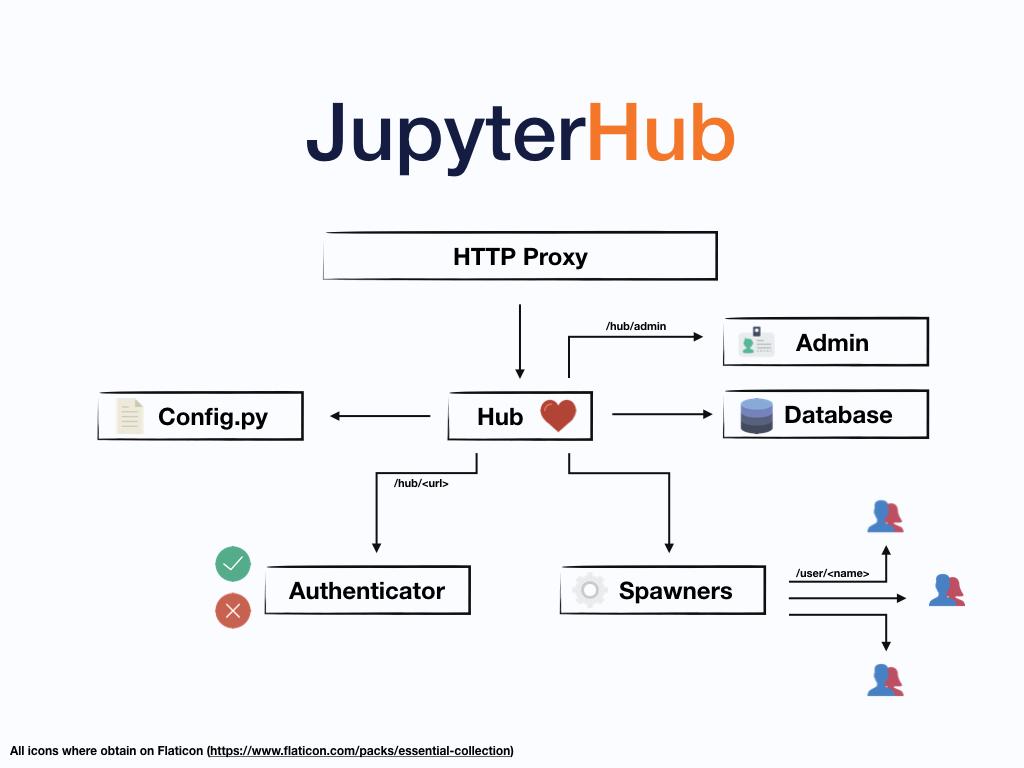
JupyterHub infrastructure diagram
Target Audience#
There are 3 key target audiences at the campus-level: students, instructors, and anyone on campus. Initially the infrastructure was created to support the instructors teaching Data 8 to 60 students in Fall 2015, with the aim from the outset of scaling Data 8 to a much larger size (1350 students as of Spring 2020), as well as to other courses and use cases campus-wide beyond Data 8 itself. Designing for scale from the start also allowed going beyond the campus audience to a global audience with [75,000 students enrolling in Data 8X on the edX platform] in Spring 2018.
For instructors this enabled an entirely new way of growing class sizes and reaching students at scale. This alleviated the burden of supporting and troubleshooting the differences in individual student laptops and personal devices, as well as updating software and notebooks over time. This was at the expense of instructors learning a new teaching toolset and workflows.
For students this enabled full access to data science environments through any device capable of running a web browser connected to the internet from any location. This alleviated the burden and inequity of requiring students to upgrade their personal computing devices to a minimum standard which would have been a barrier to widespread student participation. However this also introduced the requirement of an internet connection to be able to use the cloud infrastructure any time the student worked on class assignments, as there is no offline-mode feature available for the Datahub.
For anyone on campus with an interest in Data Science, the Datahub infrastructure was made available to everyone via standard campus Single Sign-On (SSO) credentials. This lowered the barrier for anyone curious to explore beyond the official course offerings without special access or permissions. Instructors could try out the platform by themselves; students could use the platform outside of class for their own projects or [directed group study]; researchers and scholars could experiment with how to use it in their research workflows— which spawned a Datahub variation called [BinderHub] to share reproducible interactive computing environments from code repositories for other use cases such as workshops, research collaborations, and reproducible scientific analysis. The creation of Binderhub for research on publicly available clouds to anyone in the world via <[https://mybinder.org/]> made it easy to share educational materials outside UC Berkeley to allow anyone at other institutions to interact with [open data science textbooks].
Links to Key Documents#
Autograding Cyberinfrastructure#
Overview#
Autograding allows instructors to easily and efficiently grade student assignments, and also lets students have a way to check their own progress and ensure they are headed in the right direction on the way to completing an assignment. It is an essential component of any scalable computation-centered course that includes graded assignments. There are several different options for autograding, several of which were developed by faculty and students at UC Berkeley. Choosing an autograder depends on the scale and particular requirements of a particular course.
Target Audience#
There are two main audiences: Instructors and teaching assistants who need to grade student assignments, and the students themselves who want to check their progress on an assignment and/or who are required to submit their assignments for grading.
Goals#
Enable instructors to grade student assignments at scale.
Abstract away the autograding internals in a way that is compatible with any instructor’s assignment distribution and collection pipeline.
Enable local grading on an instructor laptop, as well as server-based platforms of 3rd party learning management systems (LMSs).
Enable students to run public checks on their own machines.
Enable grading on a variety of computational formats including Jupyter notebooks, Python scripts, R Jupyter Notebooks, R scripts, and Rmd documents.
Links to Key Documents#
[The Data Science Educator’s Guide to Technology Infrastructure]
Berkeley Autograding Infrastructure on Github